AI Innovate Guru › Blog › Menu Engineering
How AI Menu Optimization Is Helping Restaurants Boost Profit by 25% in 2026
By Vivi Lin · March 3, 2026
Key Takeaway
AI menu optimization uses your POS sales data and food cost analysis to reclassify every menu item, rewrite descriptions, and restructure layout — helping restaurants increase average check size by 15-25% without raising base prices. This guide covers the exact 3-step playbook used by both enterprise chains and independent restaurants in 2026.
Your Menu Is Your Most Powerful (and Most Neglected) Profit Lever
Here is a number that should get every restaurant owner's attention: according to the National Restaurant Association, 73% of operators have never formally analyzed their menu from a profitability standpoint. They design menus based on what the chef wants to cook, not what the data says customers will buy.
The result? Money left on the table — every single service. A McKinsey report on restaurant digitization found that data-driven menu engineering can improve restaurant profit margins by 15-25%, without raising a single price or adding a single new dish.
This is where AI menu optimization comes in. And no, it does not replace your chef or strip the soul from your restaurant. It works quietly in the background, doing the math — so your team can focus on hospitality, creativity, and the human warmth that keeps guests coming back.
What Is AI Menu Optimization, Exactly?
AI menu optimization uses machine learning to analyze your POS data (your Product Mix, or P-Mix), food costs, order frequency, time-of-day trends, and even customer review sentiment. It then provides specific, actionable recommendations to restructure your menu layout, adjust pricing, rewrite descriptions, and prioritize item placement.
Think of it as a 24/7 menu consultant that never sleeps and never guesses — it only follows the data. Your chef still decides what goes on the menu. AI just tells you how to present and price it for maximum profitability.
The 4 Quadrants of Menu Engineering (Stars, Plowhorses, Puzzles, and Dogs)
Classical menu engineering, pioneered by Boston University researchers, classifies every item into four quadrants based on profitability and popularity:
- Stars (High Profit + High Popularity): Your winners. Feature them prominently — top-right of the menu, first item in a section, largest photo. AI can identify your Stars in seconds from your POS data.
- Plowhorses (Low Profit + High Popularity): Customers love them, but they are eating your margins. AI recommends subtle recipe adjustments (smaller protein portion, upcharge modifiers) or a 5-8% price increase that customers rarely notice.
- Puzzles (High Profit + Low Popularity): Hidden gold. AI suggests better descriptions, strategic placement, or server upsell scripts to move these items. A well-rewritten description alone can boost order rates by 27%.
- Dogs (Low Profit + Low Popularity): Menu bloat. AI flags these for removal. Fewer items = faster kitchen, fewer errors, lower food waste. Every item removed saves you an estimated $500-1,000/year in hidden costs.
Traditionally, this analysis requires a consultant spending 2-3 days with your spreadsheets. AI completes it in under 60 seconds — and re-runs it automatically as your sales data changes.
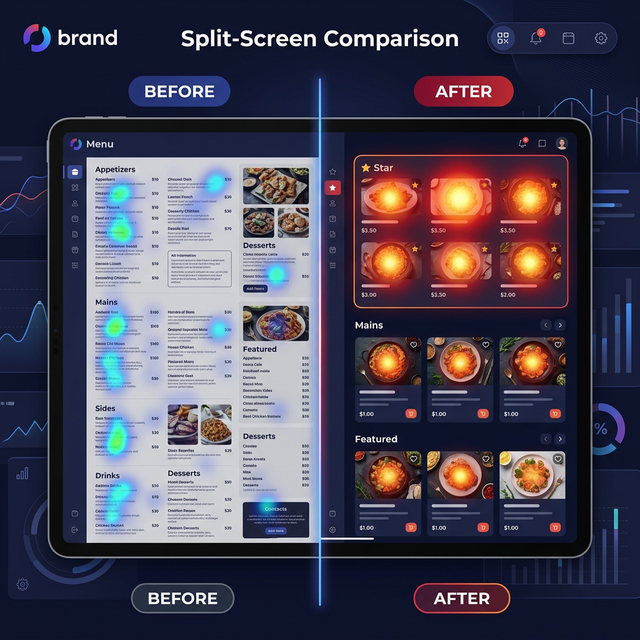
Real-World Case Studies: How Top Brands Use AI Menus
McDonald's: Dynamic Pricing at Scale
McDonald's acquired Dynamic Yield (an AI personalization company) and now uses AI to dynamically adjust its drive-through menu boards based on time of day, weather, and current wait times. During peak lunch hours, high-margin combo meals are featured more prominently. On cold days, hot beverages and soups get promoted. The result? A reported 6% average check increase across participating locations.
Chipotle: Predictive Ingredient Optimization
Chipotle uses AI not just for menu presentation, but for demand forecasting — predicting which ingredients to prep based on historical order patterns, local events, and weather. This has reduced food waste by an estimated 10-15% while ensuring popular items rarely sell out.
Independent Pizzeria: Menu Layout Restructuring
A local pizza shop we worked with (case study: Tony's Slice House) was doing 200 orders/week on DoorDash but barely breaking even. AI analysis revealed that their "Build Your Own" pizza (low margin, high decision fatigue) was cannibalizing their profitable Signature Combos. By simply moving Signature Combos to the top and shrinking the Build Your Own section, average ticket jumped from $22 to $28 — a 27% increase.
Introducing Multimodal Menu Intelligence: The 2026 Frontier
The next evolution beyond simple P-Mix analysis is what we call Multimodal Menu Intelligence — AI that simultaneously understands your menu photos, pricing structure, customer review sentiment, and competitive landscape to make holistic optimization recommendations.
For example, Multimodal AI can detect that your $18 salmon photo looks dull (low visual appeal score), your competitor prices a similar dish at $16 (competitive pressure), and customers mention "great taste but small portions" in reviews (perception gap). It then recommends: reshoot the photo with brighter lighting, add a side garnish to increase perceived value, and keep the price but add a "served with seasonal vegetables" description line.
This kind of cross-signal intelligence is what separates basic analytics from true AI optimization — and it is exactly what modern tools can now deliver.
The AI Menu Optimization Playbook: 3 Steps to Higher Profit
You can start optimizing your menu this week. Here is the exact process:
Step 1: Export Your POS Data (30 minutes)
Pull your last 90 days of sales data from your POS system (Toast, Square, Clover, etc.). You need: item name, quantity sold, selling price, and food cost per item. Export as a CSV or spreadsheet.
Step 2: Run AI Classification and Description Generation (15 minutes)
Feed your data into an AI analysis tool. It will automatically classify each item into Stars/Plowhorses/Puzzles/Dogs and generate sensory-rich, conversion-optimized descriptions. For example, "Grilled Chicken" becomes "Fire-Roasted Heritage Chicken with Herb Butter Glaze and Seasonal Root Vegetables" — descriptions that increase order rates by up to 27%.
Our Delivery Profit Maximizer tool can do this analysis specifically for your DoorDash and UberEats menus.
Step 3: Implement and A/B Test (2 weeks)
Apply the changes to your live menu. For delivery apps, you can update immediately. For dine-in, reprint the menu or update your QR code menu. Run the new layout for 2 weeks, then compare: average ticket size, food cost percentage, and total revenue versus the same period before.
Pro tip: If you are on multiple delivery platforms, change only one at first (e.g., DoorDash). Use the other (e.g., UberEats) as your control group. This gives you a clean A/B test.
What ROI Can You Realistically Expect?
Based on data from our platform and industry benchmarks:
- Average check increase: 12-25% (from description rewriting + layout optimization)
- Food cost reduction: 3-5% (from removing Dogs and reducing waste)
- Conversion rate on delivery apps: +15-20% (from better photos and descriptions)
For a restaurant doing $50,000/month in revenue, a conservative 15% check increase translates to $7,500/month in additional revenue — $90,000/year — with zero additional labor or marketing spend.
AI Assists Your Chef — It Does Not Replace Them
The number one concern we hear from restaurant owners: "Will AI make my restaurant feel corporate and soulless?"
The answer is a definitive no. AI handles the math in the background — price elasticity, margin analysis, competitive benchmarking. Your chef still creates the food. Your servers still deliver the warmth. Your brand identity stays untouched.
Think of it like GPS navigation: it tells you the fastest route, but you are still driving. You can ignore its suggestion and take the scenic route any time you want. AI is a co-pilot, never the captain.
Many chefs actually love AI menu tools because they finally have data to justify the dishes they believe in. When a chef can say "this new special has a 72% margin and tested well in the first week," the conversation with the owner goes much smoother than "I just think it will sell."
Frequently Asked Questions
1. Does AI menu optimization work for small, independent restaurants?
Absolutely. In fact, small restaurants often see the biggest impact because they have never done formal menu engineering. A neighborhood cafe optimizing its 30-item menu can realistically save 5-10% on food costs and boost average checks by 15% — translating to thousands of dollars in annual profit. Try our free menu audit to see your specific opportunity.
2. What is the best AI tool for restaurant menu design?
It depends on your needs. For delivery menu optimization, tools like our Delivery Profit Maximizer specialize in DoorDash and UberEats. For full menu engineering, look for tools that integrate with your POS. The key is to find one that provides actionable recommendations, not just data dashboards.
3. How can I use ChatGPT for restaurant menu descriptions?
You can prompt ChatGPT with: "Rewrite this menu item as a sensory-rich, appetizing description in under 20 words: [your item]." For best results, include the key ingredient, cooking method, and origin. But for systematic menu-wide optimization, you need a purpose-built tool that also accounts for pricing and profitability — not just copy.
4. How often should I re-optimize my menu?
Quarterly at minimum. Seasonally is ideal. Your best-sellers shift with weather, ingredient availability, and customer trends. AI tools that connect to your POS can flag changes automatically, so you never fall behind.
5. Will AI menu changes confuse my regular customers?
Not if done right. The best approach is gradual: update descriptions and layout first (customers rarely notice), then adjust pricing incrementally. Never remove a popular item abruptly — instead, rotate it as a "seasonal special" if margins are unsustainable.
💰 Get Your Free AI Menu Audit
Find out which menu items are Stars and which are Dogs. Our AI analyzes your delivery menu and shows you exactly where profit is leaking.
Start Free Menu AuditAbout the author: Vivi Lin is the founder of AI Innovate Guru, specializing in AI-powered growth strategies for the restaurant industry. She works with independent restaurants and regional chains across the US to implement data-driven menu engineering, local SEO optimization, and automated review management.